A customer once asked us a fair question about the ThirdReality Smart Soil Moisture Sensor Gen2: “Do I really need all of this just to check on my plant?” By “all of this” they meant a hub, a Wi-Fi router, and apparently the internet, just to know if a pot needs water.
The short answer is yes, the sensor needs a Zigbee hub. But the setup happens once, and after that you never think about the hub, the router, or anything in between again. Here is what is actually going on.
Why the sensor cannot just connect to your Wi-Fi
The soil sensor uses Zigbee, not Wi-Fi. Zigbee is a separate wireless standard built for small, battery-powered devices that need to run for a long time without anyone changing the battery. A Wi-Fi radio uses far more power, which is why Wi-Fi devices are usually plugged into the wall. A sensor sitting in a plant pot cannot be plugged in, so it uses Zigbee instead.
The tradeoff is that Zigbee devices cannot talk to your phone directly. They talk to a Zigbee hub, and the hub bridges that signal onto your home network and out to the internet. That is the whole reason the hub exists.
What happens between the sensor and your phone
This is the exact path a moisture reading takes, and it matches the diagram below.
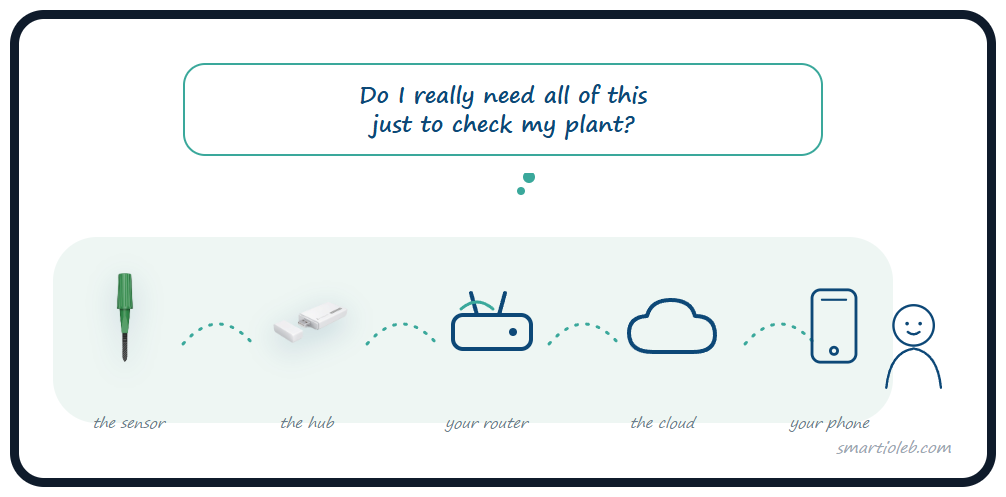
Sensor to hub, over Zigbee. The sensor’s probe sits in the soil and measures moisture directly through contact with the soil. It sends that reading over Zigbee to the ThirdReality Smart Hub Gen2 Plus, which can pick up the signal from up to about 50 meters away, through most walls and floors in a normal home.
Hub to router, over Wi-Fi. The hub is the only device in this chain that joins your home Wi-Fi. It collects the Zigbee reading and passes it on to your router, the same way your laptop or phone would.
Router to the cloud, then to your phone. From your router, the reading travels over the internet to the hub maker’s own cloud service. That service is what sends the alert to the ThirdReality app on your phone, whether you are in the next room or out of the country.
Each hop does one specific job, and none of them need your attention after the first setup.
Why this is worth it in practice
Three things come out of this setup that are easy to miss when you first hear “hub, router, cloud” and assume it means daily fiddling.
The battery lasts about two years. Because the sensor only has to reach the hub over Zigbee, not the whole internet, it uses very little power. One AA battery covers roughly two years of normal use.
You do not manage any of the middle steps. Once the sensor is paired, the hub keeps working in the background. There is no daily login, no re-pairing, nothing to check unless the battery eventually needs replacing.
You get warned before the plant actually wilts. The probe reads moisture on an ongoing basis, not just when you happen to look. That means the alert on your phone can reach you while the soil is still dry, not after the leaves have already dropped.
If you do not already have a Zigbee hub
The soil sensor is Zigbee 3.0, so it needs a Zigbee hub to work with any smart home setup, including this one. If you do not already have one, Smartio sells the matching ThirdReality Smart Hub Gen2 Plus, which is built for this sensor and the rest of ThirdReality’s Zigbee devices.
If you already run a smart home hub such as Home Assistant, Hubitat, or SmartThings, the sensor works with those directly over Zigbee as well. And if your hub bridges to Matter, the sensor’s readings can also show up in Apple Home or Google Home alongside your other Matter devices.
The sensor itself
Once it is connected, the day-to-day part is simple: a capacitive probe in the soil, a reading on your phone, and an alert before things go too dry. You can see the full details on the ThirdReality Smart Soil Moisture Sensor Gen2 product page.